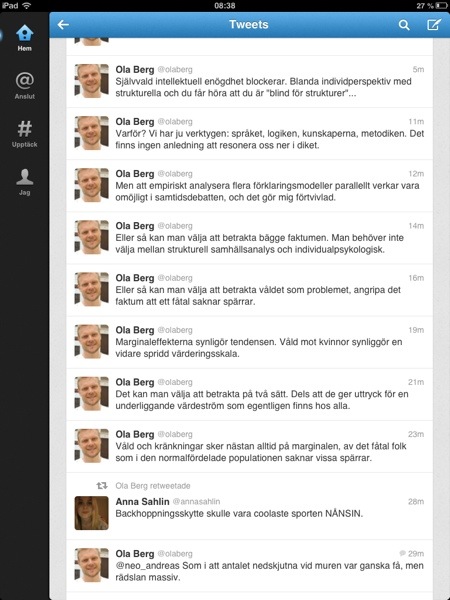
Jag försöker förstå min olust inför diskussionen. Ola Berg sötter fingret på något viktigt.

Jag försöker förstå min olust inför diskussionen. Ola Berg sötter fingret på något viktigt.

Jag tycker fortfarande att det är både roligt och fantasifullt att behåfabriken är döpt efter kupstorlekarna A-B-C (Abecita)!
Ledare som denna var inte politiskt möjliga för tio år sedan. Jämställdhetspolitiken förändras. Frågan är om diskussionerna påverkar skolans innehåll och arbetsformer?

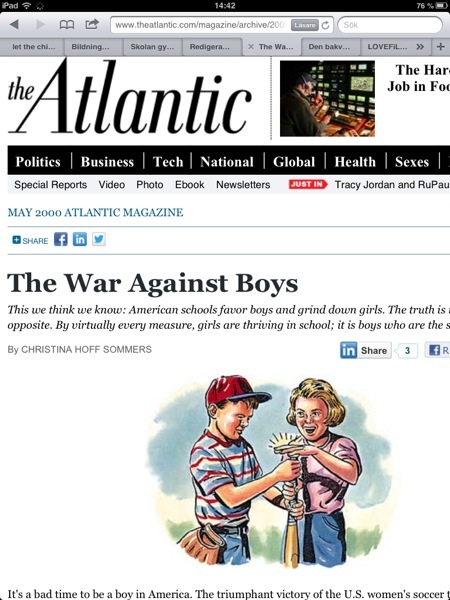
Jag är rädd att många reagerar med misstänksamhet mot den här boken. I den nya upplagan finns nytt material och en del nyanseringar. Frågan är om budskapet går att tolka som något annat än anti-feministiskt? Jag tror författaren försöker krångla sig ur den positionen.
Ibland önskar jag att vi vore mer öppna för impulser.
En länk till 46 bloggar med anknytning till Early childhood education.
Jag snubblar över en viktig text:
Behaviorists also argue that the summation of individual choices, in totality, cannot be relied upon to ensure the progress of mankind and the enhancement of the public good. The aggregate does not necessarily produce rationality; rather, it is more likely to result in inefficiency and inequality.6 The behaviorists maintain that forces, riding the rationale of the grail of competition, tend to warp the public good causing both inefficiency and inequality. Put simply, the public good is more than the sum of individual preferences and choices. The public good is beyond the exercise of self-interests. It is a great misunderstanding, indeed, a fallacy, to assume that people acting individually in their own self-interest can achieve the public good.7 We have known this since it was explained to us by Rousseau in 1758, as a cornerstone of democratic thought, that “personal interest is always in inverse ratio” to the common interest.8 Thus, a system where parents take public money and indulge their self-interests is highly problematic for the education policy of a state or nation.
Slutklämmen summerar diskussionen om friskolor:
Stiglitz quotes Alexis de Tocqueville who said that the main element of the “peculiar genius of American society” is “self-interest properly understood.” The last two words, “properly understood,” are the key, says Stiglitz. According to Stiglitz, everyone possesses self-interest in the “narrow sense.” This “narrow sense” with regard to educational choice is usually exercised for reasons other than educational quality, the chief reasons being race, religion, economic and social status, and similarity with persons with comparable information, biases and prejudices. But Stiglitz interprets Tocqueville’s “properly understood” to mean a much broader and more desirable and moral objective, that of “appreciating” and paying attention to everyone else’s self-interest. In other words, the common welfare is, in fact, “a precondition for one’s own ultimate well being.”17 Such commonality in the advancement of the public good is lost by the narrow self-interest. School tuition vouchers and charter schools are the operational models for implementation of the “narrow self-interest.” It is easy to recognize, but difficult to justify.
Jag har svårigheter att tolka Stiglitz.

Jag diskuterar musik med studenter och vi tittar på den här aningen skolkritiska filmen:
När filmen kom 1982 tyckte jag att det var en påfrestande dystopi. Nu är jag inte lika avvisande mot fabriksmetaforen. Tyvärr.
Jag skulle gärna vilja se ett liknande sociogram över de pedagoger våra blivande pedagoger möter under sin utbildning. Tyvärr tror jag att det inte skulle varit lika komplext.
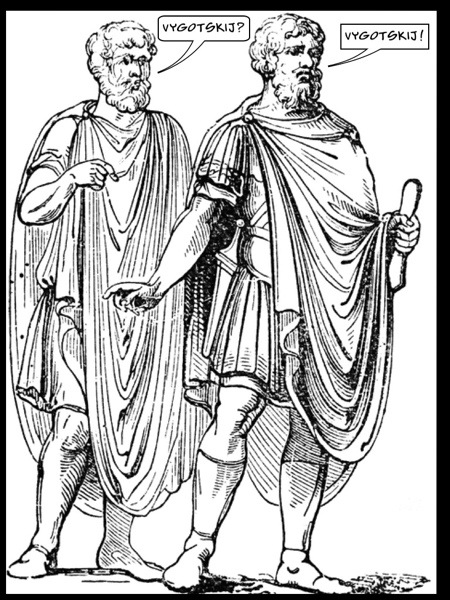
Det finns tillfällen då jag upplever det sociokulturella perspektivet som enformigt och begränsande.
Jan Lööf intervjuas i Lärarnas Tidning.
Lööf avslöjar några digitala knep och jag förstår hans försiktighet inför de oändliga valmöjligheterna i bildredigeringsprogrammet.
Annars gratulerar jag till ett bra val – Sagan om det röda äpplet är en lysande bok.

 Tysta tankar