För regelbundna läsare av bloggen är det inga nyheter. Bara påträngande viktigt.
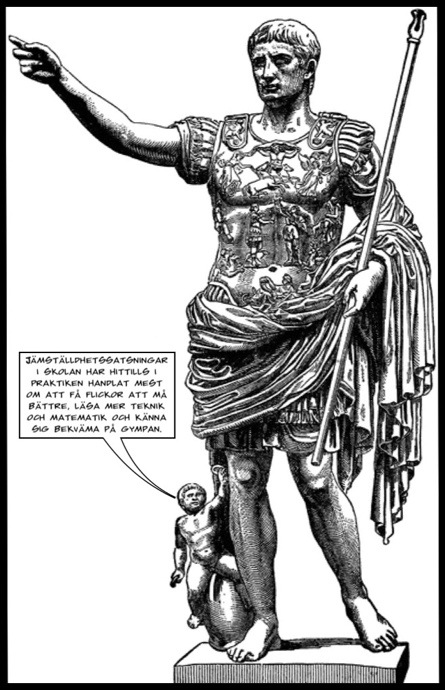

För regelbundna läsare av bloggen är det inga nyheter. Bara påträngande viktigt.
https://twitter.com/PeORehnquist/status/303810212412944384
Jag tror att längtan efter statlig styrning ofta har en nostalgisk underton. Drömmen om staten som garant för likvärdighet har ett högt pris i form av detaljstyrning. Eller går det att tänka sig att behovet av kontroll har blivit mindre idag?
Troligen inte.
https://twitter.com/statensmedierad/status/303385875214106624
Vi brukar diskutera om digital bildning är ett mål eller ett medel. Ska det vara ett eget mål som examineras för sig – eller är datorn ett redskap bland andra?
Det är nog enklare att bara göra det…
Den här typen av listor brukar göra mig deprimerad….

Jag satsar på “good enough”!
Den här artikeln kommer från Kanada:
We have a good community-college system in Canada. But that comes too late for a lot of boys. We need a massive reinvention of vocational schools, turning them from dumping grounds into places where boys can learn and thrive. Boys will be boys. Work with it.
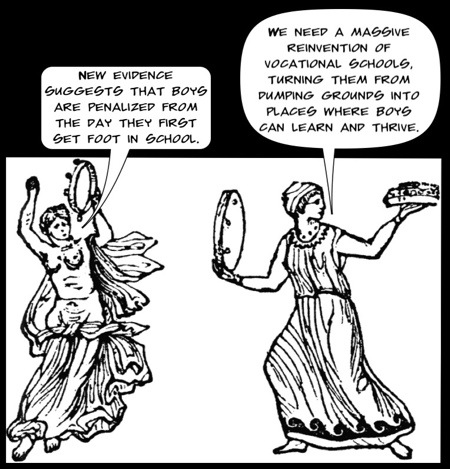
…om betyg i åk 3. Jag har dessutom förträngt Baylans lama kritik i Studio 1.
Uppdatering:
Rportaget handlade om fritidshemmet i Borås som delade upp barngruppen under sportlovet. Pojkarna bowlade och flickorna pysslade. På påsklovet byter de.
PM Nilsson säger rätt saker och påpekar att det är ett känsligt område. Men jag har lite svårt att förstå det upphetsade tonläget i reportaget och de ledande frågorna är nedlåtande mot barnen.
Personalen och rektorn ber om ursäkt och lovar bättring. Jag undrar hur det hade gått om uppdelningsbeslutet verkligen var ett uttryck för barnens vilja? Då hade det kunnat bli ett spännande reportage. Nu kunde vi självbelåtet förfasa oss över omedvetna pedagoger. Pedagogik innebär att hantera komplexa situationet.
Uppdatering 2
Jag snubblar över en viktig text:
Behaviorists also argue that the summation of individual choices, in totality, cannot be relied upon to ensure the progress of mankind and the enhancement of the public good. The aggregate does not necessarily produce rationality; rather, it is more likely to result in inefficiency and inequality.6 The behaviorists maintain that forces, riding the rationale of the grail of competition, tend to warp the public good causing both inefficiency and inequality. Put simply, the public good is more than the sum of individual preferences and choices. The public good is beyond the exercise of self-interests. It is a great misunderstanding, indeed, a fallacy, to assume that people acting individually in their own self-interest can achieve the public good.7 We have known this since it was explained to us by Rousseau in 1758, as a cornerstone of democratic thought, that “personal interest is always in inverse ratio” to the common interest.8 Thus, a system where parents take public money and indulge their self-interests is highly problematic for the education policy of a state or nation.
Slutklämmen summerar diskussionen om friskolor:
Stiglitz quotes Alexis de Tocqueville who said that the main element of the “peculiar genius of American society” is “self-interest properly understood.” The last two words, “properly understood,” are the key, says Stiglitz. According to Stiglitz, everyone possesses self-interest in the “narrow sense.” This “narrow sense” with regard to educational choice is usually exercised for reasons other than educational quality, the chief reasons being race, religion, economic and social status, and similarity with persons with comparable information, biases and prejudices. But Stiglitz interprets Tocqueville’s “properly understood” to mean a much broader and more desirable and moral objective, that of “appreciating” and paying attention to everyone else’s self-interest. In other words, the common welfare is, in fact, “a precondition for one’s own ultimate well being.”17 Such commonality in the advancement of the public good is lost by the narrow self-interest. School tuition vouchers and charter schools are the operational models for implementation of the “narrow self-interest.” It is easy to recognize, but difficult to justify.
Jag har svårigheter att tolka Stiglitz.

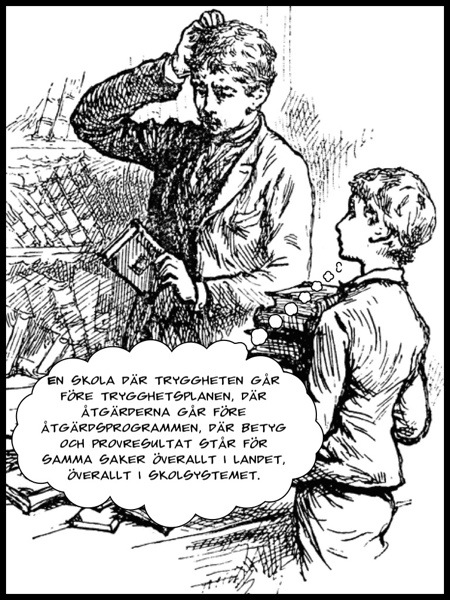

 Tysta tankar