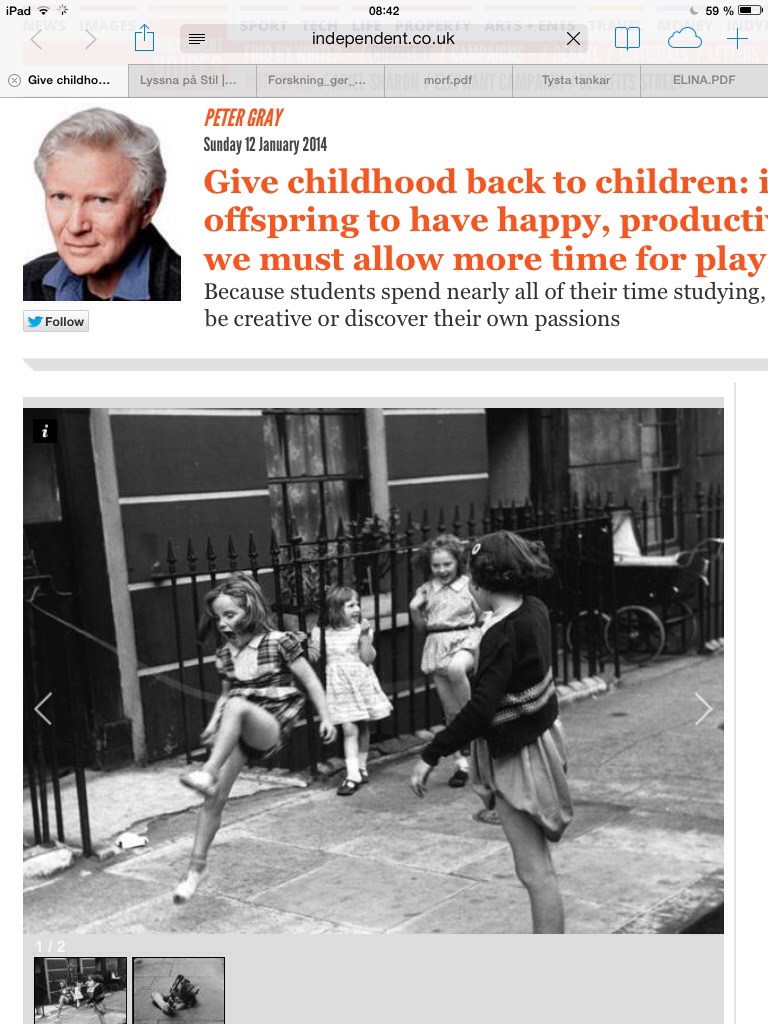
I den här artikeln driver Peter Gray tesen om 50-talet som lekens guldålder. Jag säger inte emot.
I’m lucky. I grew up in the United States in the 1950s, at the tail end of what the historian Howard Chudacoff refers to as the “golden age” of children’s free play. The need for child labour had declined greatly, decades earlier, and adults had not yet begun to take away the freedom that children had gained. We went to school, but it wasn’t the big deal it is today. School days were six hours long, but (in primary school) we had half-hour recesses in the morning and afternoon, and an hour at lunch. Teachers may or may not have watched us, from a distance, but if they did, they rarely intervened. We wrestled on the school grounds, climbed trees in the adjacent woods, played with knives and had snowball wars in winter – none of which would be allowed today at any state-run school I know of. Out of school, we had some chores and some of us had part-time jobs such as paper rounds (which gave us a sense of maturity and money of our own); but, for the most part, we were free – free to play for hours each day after school, all day on weekends, and all summer long. Homework was non-existent in primary school and minimal in secondary school. There seemed to be an implicit understanding, then, that children need lots of time and freedom to play.
I Sverige fortsätter skolans annektering av barndomen genom ett tionde skolår.
 Tysta tankar