https://twitter.com/#!/KristerHansson/status/191272036897787904
Hmmmm… det mest finns liksom redan färdigförpackat på nätet.

https://twitter.com/#!/KristerHansson/status/191272036897787904
Hmmmm… det mest finns liksom redan färdigförpackat på nätet.

Jag kör mot Malmö från Sturup i skymningen. Det är vackert och jag är ganska nöjd med livet. Hemma lyssnar jag på Peter LeMarc och inser att det finns mycket att vara tacksam för.
Att sälja Gevalia i Malmö med den här reklamen…

https://twitter.com/magnusmorck/status/191255646157553665
Det första steget är kanske att fundera över vad som har gått sönder?
“Taking a cue from Ghandi, we need to be the change that we want to see in education. As educators we are faced with two choices, either fall in line with educational reforms dictated by individuals and special interest groups who do not and have not worked in schools, or carve out our own paths that are in the best interests of our students.
Change in education is often viewed as a long, difficult, drawn-out process with the end result not being sustainable. Yes, change can be difficult, but if we are to truly transform how we teach and students learn then we must be willing to work together while acknowledging that this process will be fraught with obstacles. As we have moved from change to transformation at New Milford High School, I have found the following elements to be integral to success of many of our current initiatives. They include the following:
1. Modeling
2. Empowering staff through autonomy.
3. Shift from buy-in to embracement
4. Flexibility
5. Support (resources, professional development)
6. Shared decision-making
7. Encouraging risk-raking
8. Eliminating the fear of failure.
9. Positive reinforcement.”

Hur skapar vi en utbildning som uppmuntrar studenterna att utnyttja varandra? Idag har vi en digital lärplattform som är byggd för kontroll och administration av inlämningsuppgifter. Frågan är om det räcker för att möta framtidens krav på interaktion? Hur skulle jag reagera på att bli intvingad i ett system där lärarna kan se allt jag gör? Där strukturen inte är byggd för att underlätta kommunikation mellan studenterna?
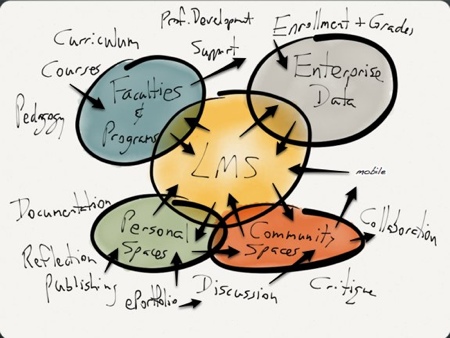
The absence of APIs from a lot of education applications, I’d argue, is a good indication that we’re still dealing in many cases with pre-Web era technologies (or at least a pre-Web era mindframe). Student information systems. Learning management systems. Educational software for your desktop computer. All pre-Web. And even newer versions of these older systems often carry forward this legacy of a world without Web (or hell, even Internet) connectivity.
APIs played a crucial part in the explosion of Web technologies. E-commerce. Social networking. Cloud computing. Now mobile computing. All facilitated by APIs. APIs have enabled companies like Facebook, Google, Amazon, and Twitter to become platforms, allowing other developers to build on top of them.
Det här måste vi diskutera på högskolan innan vi köper en ny lärplattform. Ni vet väl att de är pedagogikens Hotel California? (vad tänker jag på?)
 Tysta tankar